
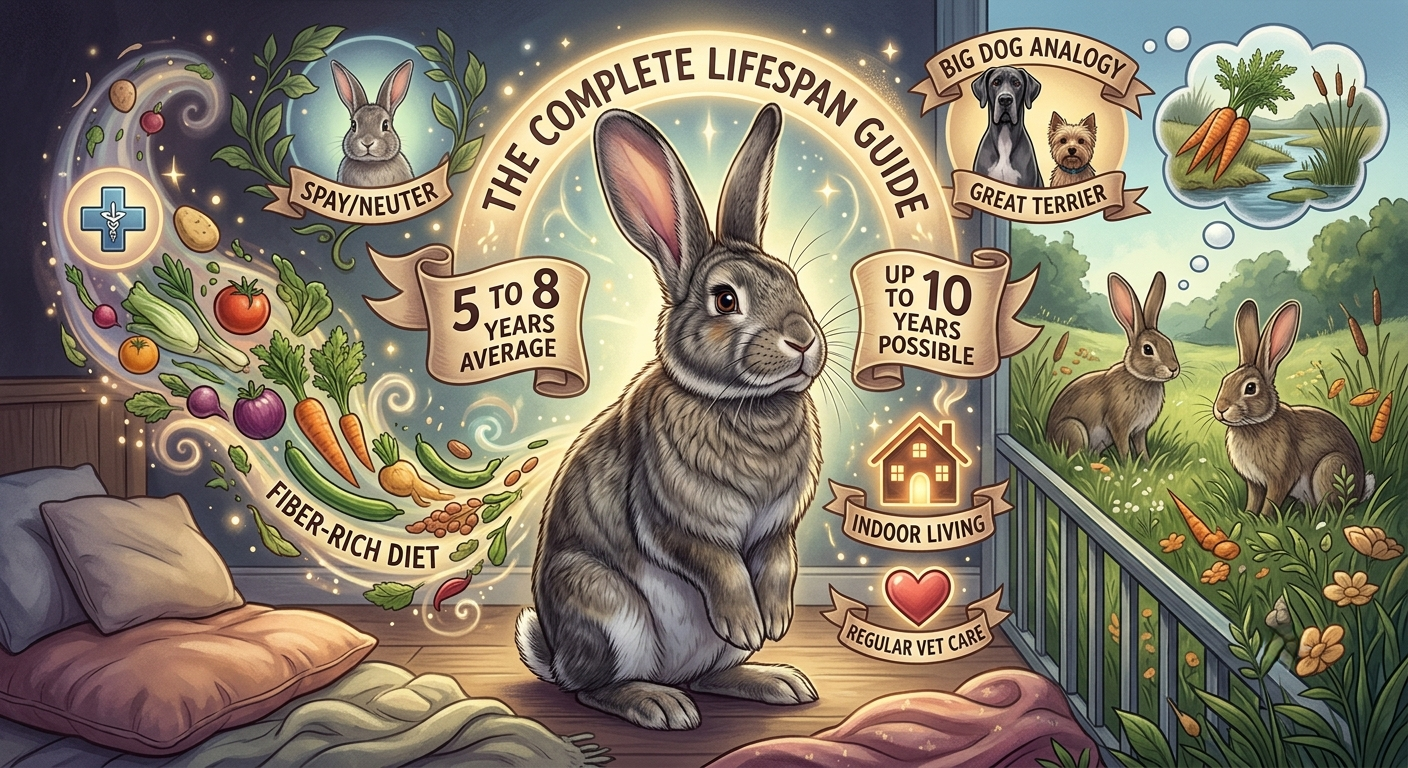
How long do Flemish Giant rabbits live is the first question every owner asks. The answer: 5 to 8 years on average, with up to 10 years possible with great care. Their lifespan is shaped almost entirely by the choices you make as their owner.
| Quick Answer: How Long Do Flemish Giant Rabbits Live? Average lifespan: 5 to 8 yearsWith exceptional care: up to 10 yearsKey factors: spay/neuter, diet, indoor living, vet careShorter lifespan than small breeds due to metabolic and cardiovascular strain |
The Average Lifespan of a Flemish Giant


How long do Flemish Giant rabbits live? Between 5 and 8 years on average. With exceptional care, some reach 10 years. Holland Lops, by comparison, routinely live 10 to 12 years. The gap is biological. A massive frame puts unique daily stress on the heart, joints, and organs.
The Big Dog Analogy: Why Giant Rabbits Live Shorter Lives

Great Danes live 7 to 10 years. Chihuahuas reach 14 to 16. The same size principle applies to rabbits. As full grown adults, these massive rabbits typically reach an average weight of 15 to 22 pounds. That rapid growth strains the cardiovascular system and skeleton from birth. Their hearts pump harder, joints carry constant load, and their metabolism runs faster all accelerating cellular aging. How long do Flemish Giant rabbits live is partly genetic, and partly how well you manage these daily physical stresses.
4 Critical Factors That Directly Impact a Flemish Giant’s Lifespan


Flemish Giant rabbits’ lifespan depends on a balanced, fiber rich diet which is very different from what Marsh rabbits eat in the wild and careful weight management to prevent severe joint strain. Additionally, providing proper temperature control to avoid heatstroke and securing regular rabbit savvy vet checkups are critical to ensuring they live a long, healthy life.
1. Spaying and Neutering

60 to 80 percent of unspayed female rabbits develop uterine cancer by age 3. That statistic alone demands action. Uterine adenocarcinoma spreads fast and silently. Symptoms often appear only after it has reached other organs. Spaying before age 2 eliminates this risk. Neutering males prevents testicular cancer and reduces stress driven aggression. How long do Flemish Giant rabbits live after spaying? A spayed female can realistically reach 8 to 10 years. An unspayed one faces cancer odds before age 3.
2. Weight Management and Joint Health


Obesity accelerates joint breakdown, strains the heart, and reduces mobility which then triggers dangerous GI stasis. Keep diet hay heavy.
Timothy hay = 80 percent of daily food. Limit pellets to a quarter cup per 6 pounds of body weight.What is the difference in life expectancy between a Flemish Giant maintained at an ideal weight compared to one that is obese?
Often a difference of 2 to 3 years.
3. Indoor Free Roaming vs. Outdoor Hutch


Temperatures above 80°F can cause life threatening heatstroke within hours. Summer hutches in direct sun are genuinely dangerous. Outdoor rabbits also live with chronic predator stress. A rabbit can die of fright from a predator encounter through the cage wire; this is called capture myopathy.
How long do Flemish Giant rabbits live indoors vs. outdoors? Indoor rabbits consistently live 2 to 3 years longer.
4. Genetics and Reputable Breeding

Ethical breeders screen for congenital heart defects, skeletal abnormalities, and dental problems. Backyard bred rabbits may carry hidden conditions that surface by age 2 or 3. Always ask about parent health history. Starting with sound genetics gives your answer to how long do Flemish Giant rabbits live the strongest possible foundation.
Major Health Challenges That Affect Their Life Expectancy

Flemish Giants are highly prone to heart conditions (like cardiomyopathy) and arthritis due to their massive size and heavy skeletal structure. Furthermore, they frequently face life threatening digestive issues like GI stasis and severe uterine cancer in unspayed females, both of which drastically shorten their life expectancy if left untreated.
GI Stasis: The Silent, Rapid Killer

GI stasis shuts down the digestive system. Bacteria multiply, gas builds, and the rabbit stops eating and drinking. Without treatment, death can occur within 24 to 48 hours.
Warning signs: no droppings for 12+ hours, hunched posture, grinding teeth, hard belly, refusal of all food. Prevention: unlimited hay, daily exercise, and prompt attention to pain from sore hocks or arthritis.
Sore Hocks (Pododermatitis) and Bedding


Sore hocks are a major killer in Flemish Giants. Their heavy bodies drive crushing pressure into back feet on hard surfaces. Standard cages and basic carpet are not enough. They need thick memory foam mats or dense vet fleece across all rest and movement areas.
Symptoms: raw red heel skin, hair loss, limping, and in severe cases, open infected wounds. Sore hock pain reduces movement, triggering GI stasis. This chain reaction is why how long do Flemish Giant rabbits live depends so heavily on proper flooring.
Arthritis and Spondylosis

By age 4 or 5, many Flemish Giants develop arthritis in the hips, knees, and spine from years of carrying their heavy bodies. Watch for hind leg weakness, reluctance to hop, or a dragging gait. Spondylosis (spinal degeneration) is especially common in the breed.
Management: vet prescribed meloxicam, low level laser therapy, and removing any jumping from their environment.
Heart Issues: Dilated Cardiomyopathy

Dilated cardiomyopathy weakening and enlarging of the heart muscle is a documented risk in heavy rabbit breeds. Signs are subtle: reduced energy, fast breathing at rest, blue gums, or sudden collapse. Bi annual vet checks become essential. This is why how long do Flemish Giant rabbits live ties so directly to regular veterinary care. Early detection allows intervention before a crisis.
The Golden Years: Caring for an Aging Flemish Giant (Ages 4+)

How long do Flemish Giant rabbits live beyond age 4 depends entirely on how you adapt their space and care. Most guides stop at prevention. This section covers what they miss.
Modifying Their Living Space


Senior Flemish Giants need specific environmental changes to stay comfortable.
- Low entry litter boxes: Swap to a shallow tray. Arthritic joints make high sides painful.
- Non slip runners everywhere: Hard floors become fall hazards as hind leg strength drops.
- No more jumping: Block sofa and bed access. Falls at this age can be fatal.
- Thicker orthopedic mats: Pressure sores worsen when seniors spend more time lying down.
- Ground level food and water: Place everything near their resting spot to encourage eating and drinking.
How long do Flemish Giant rabbits live in senior years is directly tied to how easy you make daily life for them.
Geriatric Vet Care and Bloodwork

Once your rabbit reaches age 4 or 5, annual vet visits are not enough. Move to bi annual checkups. Every visit should include: body weight check, dental inspection, heart and lung sounds, kidney/liver bloodwork, and urinalysis for bladder sludge. Catching organ decline early can add months or even years of quality life through medication and supportive care.
Dietary Adjustments for Senior Rabbits

- Reduce pellets: Switch to a timothy based senior pellet. High protein strains aging kidneys.
- Lower calcium: Cut kale and spinach. Excess calcium forms painful bladder sludge.
- Add a water source: Some seniors prefer a dish over a bottle. Hydration protects kidneys.
- Keep unlimited hay: Critical for gut motility at every age. This never changes.
- Watch weight weekly: Rapid loss signals dental issues or organ decline. Act fast.
How long do Flemish Giant rabbits live well into their golden years is a direct result of nutritional choices made throughout their life.
Frequently Asked Questions
What is the longest living Flemish Giant rabbit on record?
| No single record is universally verified, but breeders report Flemish Giants reaching 12 years under exceptional care. These cases almost always involve a spayed female, indoor living, regular vet care, and strict diet management.Reaching a decade of life is a truly extraordinary milestone for a Flemish Giant rabbit. |
Are Flemish Giant rabbits high maintenance compared to smaller breeds?
| Yes, honestly. How long do Flemish Giant rabbits live is partly a reflection of the care they receive. Their size means larger enclosures, more hay, specialized flooring, and higher vet costs. But their affectionate, gentle nature makes every bit of that effort worthwhile. |
How can I tell if my older Flemish Giant is in pain?
| Rabbits hide pain naturally. Watch for grinding teeth, a hunched posture, reluctance to move, fast shallow breathing, a tight loaf position, reduced appetite, or flinching when their back is touched. If you see these signs in a rabbit over age 4, see a vet promptly. |
How long do Flemish Giant rabbits live compared to other giant breeds?
| How long do Flemish Giant rabbits live is similar to the Continental Giant and Giant Chinchilla, most landing in the 5 to 8 year range. With reputable genetics and dedicated care, the Flemish Giant can push toward 8 to 10 years, often outperforming other giant breeds. |
Final Thoughts
How long do Flemish Giant rabbits live? Between 5 and 8 years on average. Up to 10 with great care. Spay or neuter early. Keep them indoors. Manage weight carefully. Use proper flooring. Get regular vet checks. Adapt as they age. Their health is heavily influenced by your day to day management. While caring for these domestic giants is a big responsibility, you can also explore how wild rabbits naturally manage their survival and diet. These gentle giants deserve every year you can give them.