
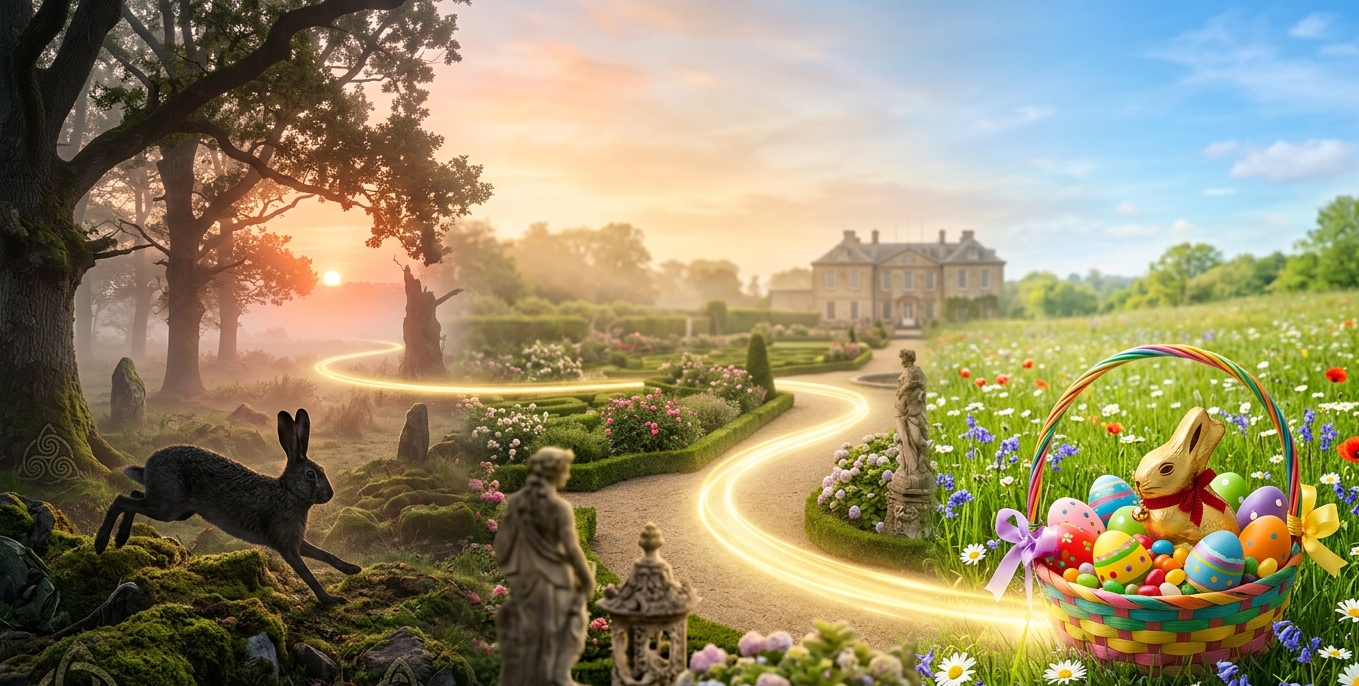
Editor’s Note: This article explores the fascinating blend of secular folklore and religious traditions that define Easter. We gently remind our readers to celebrate responsibly by opting for chocolate or plush bunnies instead of gifting live rabbits this holiday season.
Quick Answer :The Easter Bunny comes from Eostre, an ancient Germanic spring goddess whose sacred animal was the hare. In 17th century Germany, this hare became the Osterhase, a folklore character who hid colorful eggs for well behaved children. If you want to know what does a rabbit have to do with Easter?, it is the natural blending of this ancient spring symbol with the Christian symbol of the resurrection.
Every spring, children across America wake up to baskets stuffed with chocolate eggs, jelly beans, and foil-wrapped treats. All of it was supposedly left by a rabbit. Rabbits are mammals. They do not lay eggs. So why is a bunny at the center of one of the most important Christian holidays in the world? The answer goes back more than a thousand years.It starts with a goddess, travels through German villages, crosses the Atlantic, and ends in the candy aisle of your local supermarket.
The Ancient Roots: The Legend of Eostre and the Hare

To understand the history of Eostre, an ancient Germanic goddess of spring and dawn whose name likely inspired the word “Easter,” we have to look back to pre Christian Northern Europe.
If you are researching this folklore and wondering what does a rabbit have to do with Easter?, it connects directly to her spring equinox festival celebrating new beginnings (while modern bunny fans might instead search how big do lionhead rabbits get).
The Hare as Sacred Animal
Among all animals, Eostre was most closely associated with the hare. This was not a random choice. The hare is one of the most reproductively active mammals in nature. It can produce several litters in a single season. For ancient peoples who depended on the land for food, seeing hares return to the fields after winter meant one thing. Life was coming back. The hare was also a creature of the early morning.
It was often spotted in open fields at dawn, the same magical hour that Eostre herself represented. Germanic folklore called the hare a sacred messenger of the goddess. Some legends even describe a bird that Eostre transformed into a hare. According to the story, this creature kept the ability to lay eggs once a year as a memory of its former life. That tiny detail may be the oldest link between rabbits and eggs ever recorded.
Death, Rebirth, and the Power of Spring
For ancient peoples, the change of seasons felt like a miracle. Every autumn, the world appeared to die. Crops withered. Animals vanished. Cold and darkness took over. And then spring came back. Green shoots broke through frozen soil. Birds returned. Warmth returned. Life returned. Eostre was the goddess of that comeback. Her hare was the proof of it. Together, they stood for one idea: endings are not permanent. That idea would later fit perfectly into Christian belief. The 8th-century scholar Bede wrote about Eostre in his historical records. He noted that the spring month had been named after her in Anglo-Saxon tradition. The linguistic connection between her name and the word “Easter” has never been seriously challenged by historians.
From “Osterhase” to the Easter Bunny: The German Evolution

After Christianity spread through Northern Europe, the hare remained a symbol of spring in folk tradition. But it was in 17th-century Germany that the rabbit’s Easter role became truly specific. German folklore created a character called the Osterhase. The name means “Easter Hare.” This was not just a symbol. The Osterhase was a full character with a job to do. He would visit children before Easter and watch how they had been behaving. Good children got a reward. Bad children got nothing. The reward was colorful eggs, hidden in small nests. Children would tuck their caps and bonnets into hidden spots in the garden the night before. Sound familiar? The Osterhase is essentially the Santa Claus of spring. A magical figure. A gift-giver. A judge of behavior. Someone who comes once a year and never gets seen.
The Folk Fusion of Rabbit and Egg
Here is where the biology breaks down completely. The Osterhase did not just deliver eggs. He was said to lay them. Yes, a hare. Laying eggs. Impossible in real life. But folklore does not care about biology.
It cares about meaning. Both the hare and the egg were ancient symbols of fertility and new life. Both belonged to spring. Combining them into one character just made sense symbolically. The Osterhase was not just a gift-giver. He was a walking promise that spring had arrived.
Crossing the Atlantic
The Osterhase did not stay in Germany. In the 18th century, thousands of German-speaking settlers moved to the American colonies. They settled mainly in Pennsylvania. They brought their language, their customs, and their Osterhase tradition with them. The Pennsylvania Dutch community kept this tradition alive for generations. By the early 1800s, references to the Easter Hare were appearing in American writing. Then the tradition began to spread beyond German communities. The cap-nests became baskets. The eggs expanded to include candy and small gifts. The wild Germanic hare became a softer, rounder, friendlier rabbit. The Osterhase had officially become the Easter Bunny
The Christian Connection: Why a Secular Symbol Fits a Religious Holiday

A rabbit delivering eggs seems far removed from the resurrection of Jesus Christ. But the connection between the Easter Bunny and the Christian holiday is not just about calendar timing.
A Symbol Built for Resurrection
Christianity spread into a world already full of spring symbolism. Early Christians lived in farming communities. For them, spring was not just a season. It was survival. They watched life return from the dead earth every single year. The imagery of life rising from death was not a metaphor. It was something they saw with their own eyes. The rabbit, already tied to fertility and new life for centuries, fit naturally into that world. In medieval Christian Europe, the rabbit began appearing in religious art and church architecture. It became a quiet symbol of resurrection and abundance. One of the most famous examples is a ceiling motif found in medieval European churches. It shows three hares in a circle, each sharing an ear with the next, forming a perfect triangle in the center. This “three hares” design appeared in Christian churches across Germany and England. It also appeared in Buddhist temples in China and Islamic buildings in the Middle East. The same symbol. Three different faiths. One shared human instinct.
The Legend of the Sleepless Hare
Medieval Christian thinkers found another reason to value the hare. At the time, people widely believed that hares never fully closed their eyes while sleeping. They were thought to remain watchful at all times, even at rest. We now know this is not true. But for centuries, it was accepted as fact. This quality made the hare a symbol of eternal watchfulness. It connected the creature to Christ, who was believed to be always present, always aware, never overcome by darkness.
The Long Conversation Between Faiths
When Christian missionaries arrived in Northern Europe, they found communities with deep-rooted spring traditions. Many missionaries chose adaptation over erasure. Spring festivals that already existed near the time of the Christian Passover were gradually reshaped into Easter. The symbols those festivals used, eggs, flowers, and hares, were given Christian meaning. They became signs of the resurrection rather than signs of the old gods. The result was a layering of meaning, not a replacement. The same symbols now spoke two languages at once. One language was ancient and rooted in the earth. The other pointed toward heaven. Both said the same thing: death does not win.
The Great Mystery: Why Does a Rabbit Bring Eggs?
The pieces are coming together. But the core question still needs a direct answer. How did a mammal become the official delivery agent for eggs?
What the Egg Meant to Early Christians
Before the rabbit was part of Easter, the egg was already deeply meaningful.
The sealed egg was compared to the sealed tomb of Christ. Hard on the outside. Appearing lifeless. But holding something alive inside. When a chick breaks through the shell, it is reborn into the world. Early Christians saw the same pattern in the resurrection. Orthodox Christian communities across Eastern Europe made this connection very visible. They dyed their Easter eggs deep red, representing the blood of Christ. Breaking the egg at Easter was a theological act. It reenacted the opening of the tomb on the third day. The egg was not decoration. It was doctrine.
How the Two Symbols Met
The hare and the egg were always circling the same meaning. Both represented life emerging from something that looked dead. Both belonged to spring. Both carried ideas of fertility, renewal, and new beginnings. When the Osterhase tradition arrived in America and mixed with Christian Easter celebrations, the pairing was natural. The hare already gave gifts. The egg was already the gift of Easter. The two came together and stayed together. By the late 1800s, candy companies were making chocolate Easter eggs and chocolate rabbits. The union was now commercial as well as symbolic. It was not going anywhere.
Fun Facts About Easter Eggs and the Bunny
- The word “Easter” almost certainly comes from Eostre, the Germanic spring goddess.
- Greece, Serbia, and Bulgaria still dye Easter eggs red today, a tradition over a thousand years old.
- The first edible Easter eggs sold commercially were made from sugar and marzipan in early 19th-century Europe.
- Some parts of Germany still celebrate the Osterhase, not the Easter Bunny.
- Pennsylvania Dutch communities helped turn Easter egg hunts from a private family custom into a national tradition.
Modern Traditions: How the Easter Bunny Became a Global Icon

By the 20th century, the Easter Bunny had come a very long way. What started as the sacred hare of a Germanic goddess had become a commercial giant.
The White House Easter Egg Roll
The most famous Easter tradition in America is held on the South Lawn of the White House. It is called the Easter Egg Roll. The tradition started in 1878 under President Rutherford B. Hayes. Children came to roll colored eggs across the grass. It has continued almost every year since. Only wartime rationing and public health emergencies have stopped it. Today the event draws tens of thousands of children. A costumed Easter Bunny is always one of the main attractions.
Easter Baskets and the Egg Hunt Tradition
The Easter basket came directly from the Osterhase tradition. German children once left small nests made from their hats in the garden overnight. They hoped the Easter Hare would fill the nests with colored eggs. As the tradition spread through American culture, the nests became proper baskets. The contents grew too. Candy, small toys, and spring treats joined the eggs. The egg hunt followed the same path. What was once a quiet family tradition in Pennsylvania Dutch homes became a nationwide event. Today egg hunts happen in churches, schools, parks, and backyards all across the country.
The Easter Bunny as an American Icon
The 20th century turned the Easter Bunny into a full commercial institution. Chocolate makers introduced molded bunny shapes. Candy brands created Easter product lines. Shopping malls set up Easter Bunny photo booths, just like the Santa setups at Christmas. Today Americans spend billions of dollars on Easter candy every year. It is the second-biggest candy holiday after Halloween. The Easter Bunny had become the spring version of Santa Claus. A magical figure. A gift-giver. A symbol that crosses religious, cultural, and age lines.
The “Real Bunny” Dilemma: Why You Should Skip the Pet Store This Easter

Every spring, parents face the same temptation. The Easter Bunny is everywhere. The kids are excited. Baby rabbits at the pet store are adorable. Please think carefully before buying one.
What Happens After Easter
Shelters across America report the same thing every year. Rabbit surrenders spike in April, May, and June. Right after Easter. The story is always the same. A family buys a baby rabbit as an Easter gift. The kids love it for a few weeks. Then school starts again, schedules fill up, and the excitement fades. But the rabbit still needs care every single day.
Feeding, cleaning, social interaction, vet visits. The family is not prepared. The rabbit ends up at a shelter. Sometimes worse. Rabbits are currently the third most surrendered companion animal in American shelters. Easter is one of the biggest reasons why.
What Real Rabbit Ownership Actually Requires
Rabbits are wonderful pets, but they require an 8 to 12-year commitment, daily fresh greens, and proper care. If you are researching their care and wondering what does a rabbit have to do with Easter?, remember that live rabbits make poor impulse gifts. For those ready for a pet, it is essential to know their traits and how big do lionhead rabbits get to provide a proper home.
Better Choices for Easter Morning
There are better ways to celebrate rabbits this Easter.
- A soft plush bunny can be just as loved as a real one. No hay, no vet bills, no chewed furniture.
- If your family is genuinely interested in rabbit ownership, research for a few weeks after Easter. Then visit a local rabbit rescue, not a pet store.
- Or just go with a chocolate bunny. It brings the same joy, and nobody ends up in a shelter in June.
The Easter Bunny should remain magical. Real rabbits need homes that are ready for them, not just excited for them.
he Symbol of the Egg: More Than Just Decoration

The connection between the Osterhase (Easter Hare) and the egg was not a random coincidence. For centuries across various cultures, the egg has been a powerful symbol of hidden life breaking through a seemingly dead exterior. When German immigrants brought this folklore to America, painting and hunting for eggs transformed from a private ritual into a beloved, nationwide festival of spring.
Balancing Holiday Magic with Real World Responsibility

While the imagery of the Easter Bunny brings undeniable magic to children each year, it frequently leads to requests for real pets. It is vital to remember that while folklore is whimsical and effortless, caring for a living creature requires long-term commitment, specialized diets, and daily effort that extends far beyond the holiday season.
FAQs
Why Isn’t It the “Easter Chicken”?
Chickens were seen as ordinary farm animals, while the wild hare was tied to ancient spring magic. If you wonder, what does a rabbit have to do with Easter?, early Germanic peoples chose the mysterious hare as their symbol for spring’s rebirth instead of the common chicken.
Is the Easter Bunny Real? (A Guide for Parents)
For young kids, the bunny is real, but for older kids asking, “What does a rabbit have to do with Easter?“, you can share the truth beautifully. Explain that it is a centuries-old story created to celebrate spring and new life, keeping the holiday magical even as they grow up.
Why Does the Date of Easter Change Every Year?
Easter changes because it falls on the first Sunday after the first full moon on or after March 21. Since lunar and solar calendars do not match, the date shifts between late March and April. So, what does a rabbit have to do with Easter? Nothing directly the rabbit is a folklore symbol, but the date is strictly set by the moon.
Where Did Easter Baskets Come From?
They started in Germany, where children hid nests made from hats for the Osterhase (Easter Hare) to fill with colored eggs. When asking what does a rabbit have to do with Easter?, this old tradition is the exact reason. In America, those hidden hats evolved into the decorated candy baskets we see today.
How Did Easter Eggs Become Linked to the Resurrection?
Christians saved up eggs during Lent fasting, creating an abundance by Easter. Symbolically, the hard shell represented Jesus’s sealed tomb, and the hatching chick mirrored the resurrection. While asking what does a rabbit have to do with Easter? brings up the secular side of spring, the egg remains a religious symbol, often dyed red to represent Christ’s blood.
Conclusion: A Beautiful Blend of History and Hope
The Easter Bunny may seem like logical nonsense a mammal delivering eggs, combining pagan symbols with a Christian holiday. But it works because every tradition within it points to the exact same message: winter is hard, but spring always returns.
When people ask, what does a rabbit have to do with Easter?, the answer is found in this timeless celebration of hope and new life (though if you want a real pet, you should research how big do lionhead rabbits get).
Recent Changes to This Post
- Enhanced History: Updated the text to provide a clearer timeline of how the Germanic Osterhase evolved into today’s Easter Bunny.
- New Welfare Guidelines: Added critical information regarding responsible pet ownership and the risks of gifting live rabbits during the holidays.
- Improved Readability: Reorganized the article with clearer subheadings and a quick-reference FAQ section for an easier reading experience.
Author’s Note: As a writer fascinated by history, tracing the Easter Bunny’s journey from an ancient goddess to modern candy aisles was a joy. I hope this piece inspires you to appreciate the deep, shared human themes of hope and renewal this spring. ZIB