
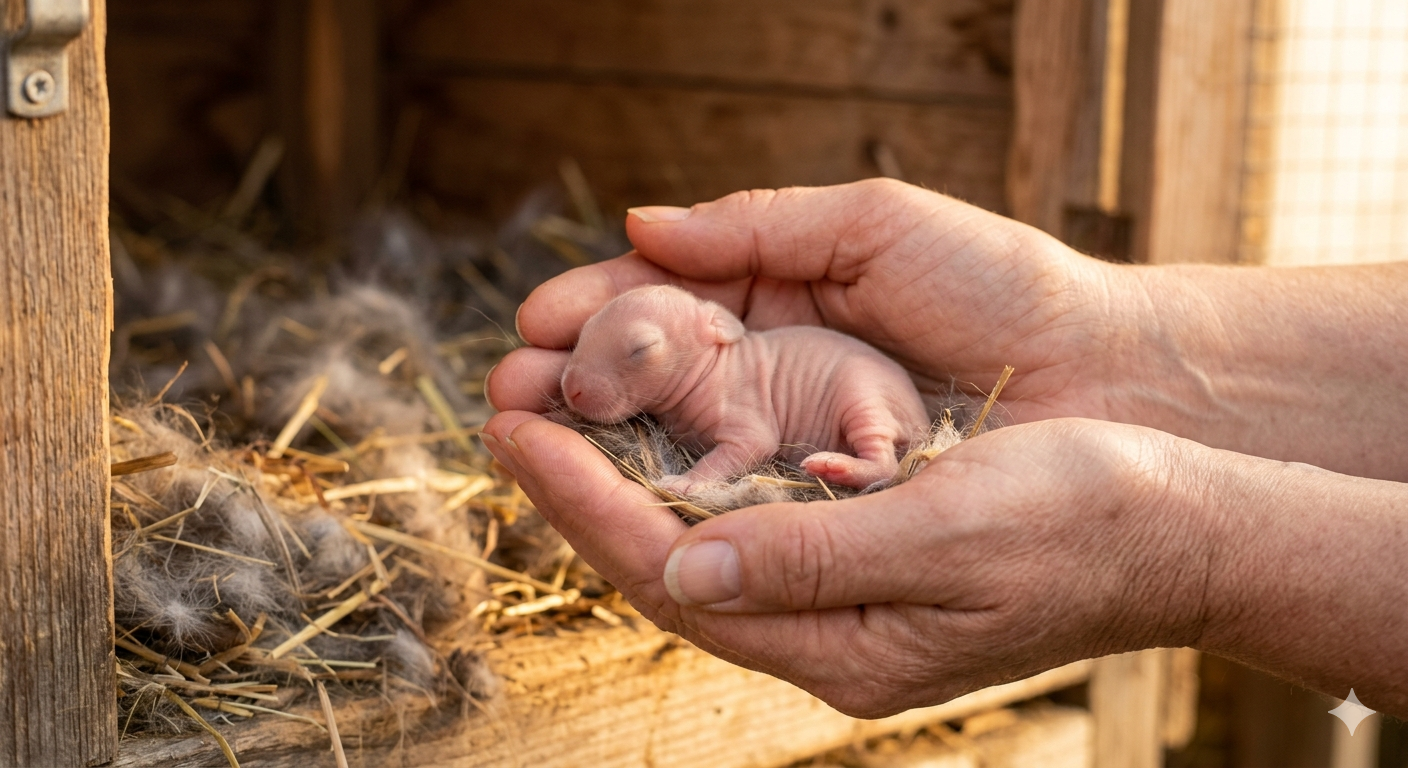
A Step by Step Rescue Guide for Panicked Breeders
Editor’s Note: This article has been revised to include the latest 2026 standards for neonatal lagomorph care. We have added specific sections on post resuscitation “Golden Hour” care and updated the safety warnings regarding the Swing Method to ensure the highest survival rates for your litter.
| Quick Answer Baby rabbits may not breathe immediately due to amniotic fluid blockage, hypothermia, or birth exhaustion.A still kit is not always dead. A stunned kit can often be saved within the first 20 minutes.Clear the airway first, warm the kit, then use the Swing Method to drain trapped lung fluid.Check for a faint heartbeat, nostril moisture, or any muscle response to confirm the kit is stunned, not stillborn.Do not give up early. Commit to a full 20 minute resuscitation window before accepting the outcome. |
Why Rabbits Did Not Start Out Immediately: Causes and Step by Step Rescue Guide

Why rabbits did not start out immediately after birth is the urgent question every breeder faces when a newborn kit lies completely still in the nest. But a still kit is not always a dead kit. Many newborns that appear lifeless at birth are simply stunned, and they can be saved if you act within the right window.
This guide tells you exactly why it happens, how to tell the difference between stunned and stillborn, and what to do step by step right now.
The Science: Why the Delay in Breathing?

Baby rabbits may not breathe immediately after birth due to three main causes: amniotic fluid trapped in the lungs, hypothermia from sudden cold exposure, or exhaustion from a difficult delivery (dystocia).
Fluid in the Lungs (Amniotic Fluid)
Inside the womb, a kit’s lungs are filled with amniotic fluid throughout pregnancy. At birth, that fluid must clear before the first breath of air can enter. This fetal to neonatal transition does not always happen on its own. Without the mother’s immediate stimulation, fluid stays trapped and the kit cannot breathe. This is the most common reason a kit appears lifeless at birth.
Temperature Shock (Hypothermia)
Kits are born hairless. The moment they leave the womb, body heat drains rapidly, especially on a cold surface. Hypothermia shuts down metabolism and makes a kit appear dead. Gradual, gentle warming can reverse this faster than most breeders expect.
Difficult Birth (Dystocia) Exhaustion
A kit that arrived after a long or awkward delivery may simply lack the energy to trigger its own breathing reflex. It needs your help to get those first breaths started.
Is It Stillborn or Just Stunned? (The 3 Second Test)

Run through these three checks before doing anything else.
Check 1: Heartbeat
Place your fingertip gently on the kit’s chest just behind the front legs. Rabbit hearts beat over 200 times per minute. Even a faint flutter means the kit is alive.
Check 2: Nostrils
Hold the kit near your cheek or a small mirror. Any warmth or faint moisture from the nose means air is still moving.
Check 3: Foot Reflex
Press a fingernail lightly against the sole of a back foot. Watch closely for any small muscular response, no matter how subtle.
Use this table to compare what you are seeing:
| Sign to Check | Likely Stunned (Act Now) | Likely Stillborn (Observe) |
| Body Color | Pink or slightly blue tint | Completely gray or white |
| Heartbeat | Faint pulse detectable | No heartbeat at all |
| Muscle Tone | Some stiffness or slight flex | Completely limp, no resistance |
| Response to Touch | Tiny twitch or flinch | Zero reaction whatsoever |
| Nose/Mouth | Trace of moisture or movement | Dry, sealed, no movement |
| Time Since Birth | Under 30 minutes | Unknown or very long time |
If even one sign points toward Likely Stunned, move immediately to the resuscitation steps below.
Step by Step Guide to Resuscitate a Non Starting Kit

Work through these four steps in order. Do not skip ahead.
Step 1: Clear the Airways
Use a small bulb syringe to gently suction the nostrils and mouth. No syringe? A clean soft cloth works too. Tilt the head slightly downward so gravity helps drain any loose fluid.
| Pro Tip: A soft cloth is often faster than a syringe at 2 AM. Use whatever is clean and within reach. |
Step 2: Warm the Kit
Fill a zip lock bag with warm water (35 to 38 degrees Celsius, comfortable on your wrist). Wrap it in a cloth and rest the kit on top. Holding the kit in cupped palms also works well.
Do not use high heat pads and do not submerge the kit. Slow, steady warmth is the goal.
| Safety Warning: Never use boiling water or a microwave near the kit. Burns can occur even through a cloth barrier. |
Step 3: The Gentle Swing Method
Wrap the kit firmly in a soft cloth with its head pointing toward your fingers. Stand over a bed or folded towel. Using a smooth downward arc, swing the kit like a slow pendulum, 3 to 5 times. This uses centrifugal force to push fluid out of the airway. Wipe the nose and mouth immediately after each pass.
| Safety Warning: Never swing over a hard floor. Never jerk or shake sideways. The motion must be smooth, controlled, and downward only. |
Step 4: Friction and Stimulation
Rub the kit’s back and sides firmly with your thumb and finger, mimicking how a mother rabbit licks her kits. You can also tap the soles of the feet to trigger the breathing reflex. Keep alternating between warming and friction for the full rescue window.
| Pro Tip: Holding the kit against your bare chest adds steady warmth while you work. |
Common Mistakes Breeders Make in the First 5 Minutes

In a panic, even experienced breeders make costly errors. Knowing them in advance can be the difference between a kit that survives and one that does not.
| Common Mistake | What to Do Instead |
| Giving up after 30 seconds | Keep trying for up to 20 minutes |
| Using very hot water | Use warm water, 35 to 38 degrees C only |
| Shaking the kit too hard | Use slow, controlled pendulum swing |
| Putting kit back too soon | Wait until breathing is stable |
| Skipping airway check | Always clear nose and mouth first |
Giving Up Too Soon
Kits have been revived after 15 to 20 minutes of appearing lifeless. Set a timer and commit to that full window. Fatigue makes time feel longer than it is.
Using Water That Is Too Hot
Always test warming water on your wrist first. It should feel comfortable, not hot. Even mildly hot water can burn tissue too fragile to protect itself.
Rough Handling
Every motion must be deliberate and gentle. The kit’s organs, spine, and skull are extremely soft. Stimulate and support. Never force.
When to Accept Nature: Signs You Cannot Fix

Not every kit can be saved. Stop resuscitation if you see any of the following.
- Body is completely rigid (rigor mortis) with zero flexibility.
- Skin has turned dark gray, purple, or black.
- Visible physical deformity such as malformed skull, spine, or absent limbs.
- No heartbeat, no reflex, no nose response after a full 20 minutes of active effort.
- Foul smelling or discolored amniotic sac, indicating the kit died before delivery.
If you reach 20 minutes with no response, it is okay to stop. You did everything right.
The Critical ‘Golden Hour’: Beyond the First Breath

Once a kit begins to gasp or twitch, the battle is only half won. The first 60 minutes following resuscitation the “Golden Hour” is when the kit is most vulnerable to a relapse. After a kit has been revived from a stunned state, its metabolic rate is erratic, and its internal temperature remains dangerously unstable. It is vital to understand that a kit breathing again is not yet a kit out of danger; it requires constant monitoring to ensure the transition to life is permanent.
Optimizing Neurological Recovery and Oxygenation

The primary focus during this stage is Neurological Oxygenation. Because the kit suffered a period of oxygen deprivation (hypoxia), it may appear lethargic or “floppy” even while breathing. To support brain recovery and lung function, keep the kit in a “head-up” position at a 45 degree angle. This specific positioning reduces intracranial pressure and makes it significantly easier for the kit’s underdeveloped diaphragm to pull in life saving oxygen, preventing a secondary collapse.
Preventing Secondary Hypothermia and Stabilizing Metabolism

Furthermore, you must address Secondary Hypothermia. Many breeders make the mistake of returning a revived kit to the nest immediately. However, a mother rabbit’s nest only maintains existing heat; it cannot actively raise the temperature of a cold kit. If the kit’s core temperature is below 35°C, it cannot digest milk, and its heart rate will eventually slow back down to a stop. Keep the kit in a dedicated “warming box”a small container lined with fleece and a safe heat source until it is warm to the touch and actively “searching” for a nipple.
Testing the Suckling Reflex for Final Stability

Before returning the kit to the doe, monitor for the Suckling Reflex. Gently place a clean finger near its mouth; if the kit attempts to latch or nibble, its neurological system is firing correctly. If the kit remains limp after two hours of warmth, it may require a drop of 5% glucose water (only under expert guidance) to jumpstart its energy levels. By bridging the gap between resuscitation and re-nesting, you increase the long-term survival rate from 40% to nearly 90%.
Frequently Asked Questions
What Is the Survival Window for a Non Breathing Kit?
A kit can potentially be revived within 15 to 20 minutes of birth if the body has not fully cooled. Treat that window as your firm commitment point. Some kits respond near the end of it. The only way to know is to keep going.
Why Is the Mother Rabbit Not Helping?
Rabbit does have different instincts from cats or dogs. A doe may be exhausted after a difficult labor, or a first-time mother may not yet know what to do. It is not abandonment. Step in when she does not.
Should I Return the Kit to the Nest Right Away?
Wait until the kit is breathing steadily and moving on its own. A kit placed back too soon may lose heat again or be pushed aside. Once stable, return it to the center of the nest and monitor the doe for the next hour.
What If I Do Not Have a Bulb Syringe?
A clean soft cloth works for clearing the mouth and nostrils. The Swing Method clears deeper fluid passively. Do not delay starting because you lack a specific tool.
Can I Try Mouth to Mouth on a Kit?
Yes, carefully. Cup the kit’s entire head in your mouth and use only the smallest puff of air imaginable. The lungs of a newborn rabbit are no larger than a small grape. Even a fraction too much air can rupture tissue that is simply not built to handle adult level breath force. Use this alongside warming and the Swing Method, not alone.
Final Thoughts: A Delay Is Not Always the End
A newborn rabbit that does not start breathing immediately is not automatically gone. Amniotic fluid blockage, hypothermia, and birth exhaustion are all hurdles, not death sentences. Clear the airway. Warm the kit. Swing. Stimulate. Give that kit the full 20 minutes. Many breeders have been exactly where you are right now, and ended the night with a breathing kit tucked back in the nest.
You can be one of them. Go.
What’s New in the 2026 Edition?
We have updated this guide with the latest neonatal rabbit care protocols to move beyond basic resuscitation. The 2026 version includes:
- The “Golden Hour” Protocol: A new critical care framework for the first 60 minutes after a kit starts breathing to prevent sudden relapse.
- Neurological Oxygenation Tactics: Instructions on the 45 degree “head up” positioning to reduce intracranial pressure and aid brain recovery after oxygen deprivation (hypoxia).
- Secondary Hypothermia Prevention: Updated thermal safety standards, explaining why a nest is insufficient for a revived kit until its core temperature reaches 35°C.
- The Suckling Reflex Diagnostic: A new physical test to verify neurological stability and metabolic readiness before re-introducing the kit to the doe.
- Metabolic Jumpstarting: Expert-level guidance on identifying when a kit needs glucose intervention to survive the first two hours.
Author’s Note: As a breeder, there is no moment more heart-stopping than finding a “still” kit. This guide was born out of years of hands on experience and late-night rescues. My goal is to replace your panic with a protocol. Remember: nature is resilient, but sometimes it just needs a 20 minute head start from us.