
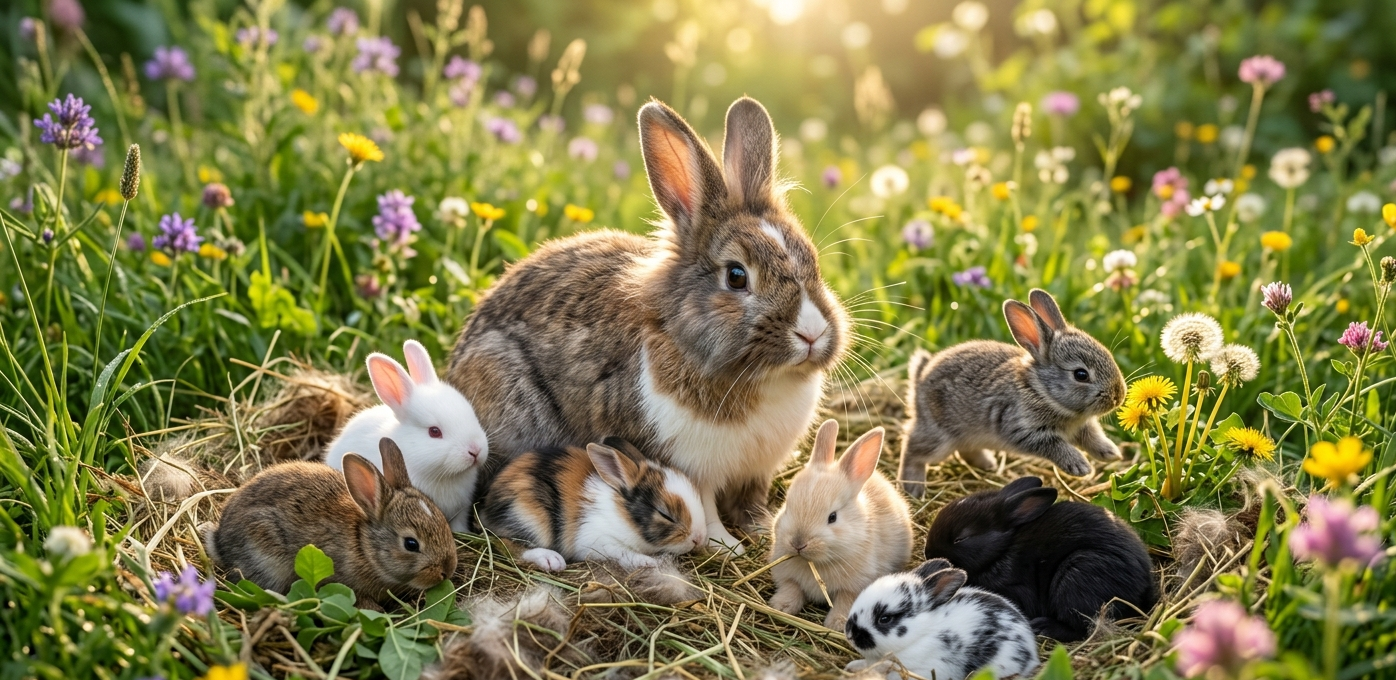
You walk into your backyard and spot a small patch of fur tucked into the grass. Or maybe your pet rabbit just gave birth and you have no idea how many babies to expect. Either way, you are about to get answers. Rabbits are one of the most prolific mammals on earth, and understanding their reproductive habits can help you care for them better, or simply know what to do if you find a wild nest.
| Quick AnswerHow many young do rabbits have? Domestic rabbits typically have 5 to 8 kits per litter. Wild rabbits average 3 to 6 kits. A single doe can produce up to 12 litters per year. The gestation period is just 28 to 31 days, making rabbits one of the fastest-reproducing mammals on earth.Key Facts at a Glance:Domestic litter size: 5 to 8 kits (range: 1 to 14)Wild litter size: 3 to 6 kitsGestation period: 28 to 31 daysLitters per year: Up to 12 (domestic), 3 to 4 (wild)A baby rabbit group is called: A Kindle |
How Many Young Do Rabbits Actually Have?
Litter sizes vary based on whether a rabbit is wild or domestic, and on the individual doe herself.

Domestic Rabbits
Most domestic does give birth to 5 to 8 kits per litter. However, the range can be as wide as 1 to 14, depending on the breed and the health of the mother. First-time mothers tend to have smaller litters. A young doe having her first kindle may only produce 2 to 3 kits. With each subsequent pregnancy, litter sizes usually increase until the doe reaches her prime reproductive years.
Wild Rabbits
Wild Eastern Cottontail rabbits, the most common species in the USA, average 3 to 6 kits per litter. Their smaller litter size is partly a survival adaptation, since larger litters are harder to keep warm and hidden from predators. Wild rabbits have 3 to 4 litters per year. Their breeding season runs mainly from February through September, peaking in spring.
Annual Frequency
Here is what makes rabbits so remarkable. A domestic doe can theoretically have up to 12 litters per year. With a 28 to 31 day gestation period and the ability to become pregnant again within hours of giving birth, the math adds up fast. In practice, responsible rabbit breeders limit does to 4 to 6 litters per year to protect the mother’s health.
What Determines Litter Size?

Several factors work together to influence how many kits a doe produces.
Breed Differences
Breed is one of the biggest predictors of litter size. Smaller breeds tend to have fewer kits, while larger breeds can support more. Here is how some popular breeds compare:
| Breed | Size | Avg Litter | Max Litter | Notes |
| Netherland Dwarf | Small (2 lbs) | 2 to 4 | 6 | Smallest litters due to small body size |
| Mini Rex | Small-Med (4 lbs) | 4 to 6 | 8 | Popular pet breed, moderate litters |
| New Zealand White | Large (9 lbs) | 8 to 10 | 14 | Common meat/lab breed, large litters |
| Flemish Giant | Giant (14+ lbs) | 5 to 8 | 12 | Large body but moderate litter size |
| Holland Lop | Small (4 lbs) | 3 to 5 | 7 | Dwarf type, smaller litters |
| Californian | Large (9 lbs) | 6 to 8 | 12 | Meat breed, consistently large litters |
As you can see, body size is a strong factor, but it is not the only one. Genetics, selective breeding history, and the specific purpose of the breed (pet vs. meat) all play a role.
Environmental Factors
For wild rabbits, food availability and daylight hours directly affect how many litters they produce and how large those litters are. In years with abundant food, wild rabbit populations tend to boom. In drought years or when vegetation is sparse, reproduction slows down. This is nature’s way of keeping populations balanced with available resources.
The Mother’s Age and Health
A young doe under 6 months of age should not be bred at all. Her body is still developing, and early breeding can stunt her growth and reduce lifetime productivity. Peak reproductive age for domestic does is roughly 8 months to 3 years. After age 3, litter sizes typically begin to decline. Nutrition matters enormously. A doe on a diet deficient in protein, fiber, or key vitamins will produce fewer kits, and those kits may be weaker at birth.
Wild Rabbit Nesting: What to Do If You Find One
Finding a rabbit nest in your yard is surprisingly common, especially in spring. Knowing what to do can make the difference between a nest that thrives and one that gets accidentally destroyed.
Identifying a Healthy Nest
What it looks like: A shallow depression in the ground, about the size of your hand, lined with dry grass and covered with a layer of fur pulled from the mother’s belly.
Where to find them: Open areas of lawns, gardens, and fields. Cottontails do not hide their nests in brush, which surprises many people.
Signs of a healthy nest: Kits are warm, round-bellied, and tucked tightly together. The fur covering is intact.
The 24-Hour Myth
Many people believe that if they have not seen the mother near the nest, the babies are orphaned. This is almost never true.
Mother rabbits only visit the nest twice a day: once around dawn and once around dusk. They stay away during the day to avoid drawing predators to the nest.
If you hover near the nest or check on it repeatedly during the day, you will not see the mother return. That does not mean she has abandoned her kits.
The String Test: Step-by-Step

This is the most reliable way to check if a mother rabbit is still caring for her young.
- Gather two pieces of string or yarn, each about 12 inches long.
- Lay them in an X pattern directly over the top of the nest opening.
- Leave the area completely and do not return until the next morning.
- Check the strings at dawn. If they have been disturbed or moved, the mother returned overnight.
- If the strings are undisturbed after two full nights, the kits may be orphaned. Contact a licensed wildlife rehabilitator.
Do not attempt to raise wild rabbit kits yourself. They have a very specific diet and high stress levels in captivity. Untrained handling dramatically reduces their survival rate.
Survival and Development: From Pinkies to Hoppers

Baby rabbits, called kits or kittens, go through rapid changes in their first few weeks of life.
Week 1: Pinkies
Newborn kits are born hairless, blind, and deaf. Their skin appears pink due to the visibility of blood vessels beneath the surface. They weigh roughly 1 to 2 ounces at birth. At this stage, they rely entirely on their mother’s milk and on each other’s body heat to survive.
Week 2: First Fur and Senses
By day 10, a fine coat of fur has grown in. The eyes begin to open around day 10 to 12. The ears follow shortly after. Kits become noticeably more active during this week, though they remain in the nest.
Week 3 to 4: Hoppers
This is when kits begin exploring outside the nest. They start nibbling on solid food alongside their mother’s milk. By 3 to 4 weeks of age, wild kits are fully independent. They are roughly the size of a golf ball at this stage, which often makes people think they are still too young to be on their own. They are not.
A wild rabbit the size of a baseball with open eyes and erect ears does not need human intervention. It is perfectly capable of fending for itself.
Common Myths and Misconceptions

Myth: If You Touch Baby Rabbits, the Mother Will Reject Them
This is false. Rabbits do not have the same scent-based rejection response that some other animals show. If you accidentally disturb a wild nest, you can gently replace the kits and cover them back up with the fur and grass. The mother will almost always return that night. The smell of humans does not cause abandonment in rabbits.
Myth: You Can Feed Orphaned Kits Cow’s Milk
Do not feed wild or domestic orphaned kits cow’s milk. It has the wrong nutritional composition for rabbits and can cause fatal digestive failure within days. If you have orphaned kits that genuinely need feeding, contact a wildlife rehabilitator immediately. They use specially formulated kitten milk replacer (KMR) in specific dilutions. Even with proper nutrition, orphaned wild kits have a low survival rate without professional care.
FAQs: People Also Ask
How Many Babies Do Rabbits Have in Their First Litter?
First litters are typically smaller than average. A young doe may have only 1 to 3 kits in her first kindle. This is normal. Litter sizes increase as the doe matures and her body fully develops for reproduction.
Do Rabbits Eat Their Young?
This does happen, but it is less common than many people believe, and it is almost always triggered by a specific cause. A doe may consume a stillborn kit to remove it from the nest and prevent infection. In rare cases, a very stressed or malnourished first-time mother may harm living kits. Ensuring the doe has a private, quiet nesting area and adequate nutrition dramatically reduces the risk of this behavior.
How Can I Tell If a Baby Rabbit Is Truly Orphaned?
- Wild kit: Perform the string test over two nights. If the strings remain undisturbed, the mother has not returned.
- Domestic kit: Check if the mother is pulling fur to build a nest. If the doe is present but ignoring the kits for more than 24 hours, consult a rabbit-savvy veterinarian.
- Signs a kit needs help: Cold, wrinkled skin, crying persistently, visible injuries, or found alone far from any nest.
How Long Are Rabbits Pregnant?
The gestation period for both domestic and wild rabbits is 28 to 31 days. This is one of the shortest gestation periods of any mammal, which is a major reason rabbits reproduce so rapidly.
When Do Rabbits Stop Reproducing?
Domestic does can reproduce until age 4 to 5 years, but their fertility declines significantly after age 3. Bucks remain fertile longer, often until age 5 to 6 years.
Final Checklist and Summary
Here is a quick reference to take with you:
Key Numbers to Remember:
- Domestic litter size: Average 5 to 8 kits (up to 14 maximum)
- Wild litter size: Average 3 to 6 kits
- Gestation period: 28 to 31 days
- Eyes open: Day 10 to 12
- Leave the nest: 3 to 4 weeks (wild), 6 to 8 weeks recommended for domestic pets)
- Annual litters (domestic): Up to 12 (recommend limiting to 4 to 6)
If You Found a Wild Nest:
- Leave it alone if the kits look warm and round-bellied.
- Do the string test before assuming the mother is gone.
- Call a licensed wildlife rehabilitator if the string test confirms two missed visits.
- Never feed wild kits cow’s milk. It causes fatal digestive failure.
- A baseball-sized kit with open eyes is independent and needs no intervention.
Rabbits are extraordinary animals. Their speed of reproduction is matched only by their ability to fill an ecological niche across almost every habitat in North America. Whether you are a pet owner preparing for a litter, a backyard gardener who stumbled on a nest, or just curious about how nature works, the best thing you can do is observe, respect their biology, and step in only when the evidence is clear. When in doubt, leave them be. And if professional help is truly needed, your local wildlife rehabilitation center is just one call away.