
what is rabbit dentition scientific data
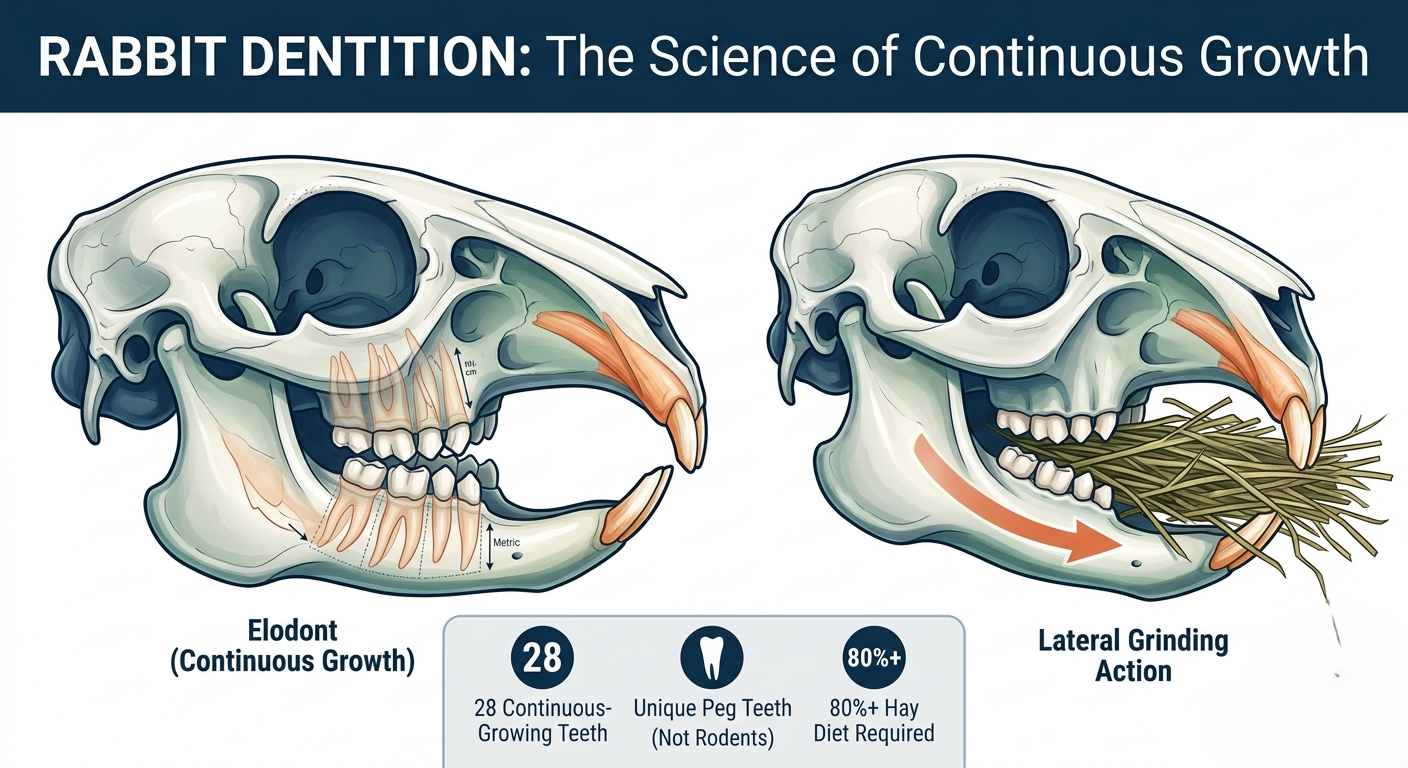
| Quick Answer So what is rabbit dentition scientific data? Rabbits have 28 teeth that keep growing. These teeth are of four types: 1 incisors 2 peg teeth 3 premolars 4 molars Unlike rodents rabbits have a second pair of upper incisors. These are called peg teeth. Rabbits use their incisors and peg teeth to eat and chew food.All teeth grow 2 to 3mm per week and must be worn down by hay. Without that wear, Acquired Dental Disease (ADD) sets in the leading preventable killer in pet rabbits. |
Why Rabbit Dental Health Is More Complicated Than You Think

Continuous Growth: Rabbit teeth never stop growing, meaning they require constant grinding from a fiber-rich diet to prevent painful overgrowth and severe dental disease.
Hidden Issues: Because their cheek teeth are tucked far back in a narrow mouth, major dental problems can develop completely out of sight until the rabbit stops eating entirely.
Rabbits Are Not Rodents

Most US rabbit owners assume their pets are rodents. They are not. Rabbits is the part of the Order Lagomorpha. This is a different group of animals. Rabbits are actually very distinct, from animals because they belong to the Order Lagomorpha The thing that shows us this is their teeth. You see rodents have one pair of teeth in the top of their mouth but rabbits have two pairs of these big teeth.
This is one of the reasons why rabbits are not like other animals, like rodents and that is why they are classified under Order Lagomorpha. Rabbits are really unique. That is why they belong to Order Lagomorpha. That second pair, called peg teeth, is the anatomical signature of every lagomorph. Understanding what is rabbit dentition scientific data starts here, because rabbit dental protocols are fundamentally different from those used for any rodent species.
Teeth That Never Stop Growing

Every one of your rabbit’s 28 teeth grows continuously for life. Incisors grow about 2 to 3 millimeters every week. Wild rabbits eat plants with lots of fiber for 14 to 16 hours each day. This helps wear down their teeth at the rate that they grow Domestic rabbits on soft pellets lose that wear. The teeth keep growing. Problems follow.
The Anatomy of Rabbit Teeth: What the Science Shows

Open-Rooted Dentition: Unlike humans, rabbits have “elodont” teeth, meaning they lack true roots and grow continuously throughout their entire lives.
The “Peg” Teeth: Rabbits have a unique second pair of small incisors hidden directly behind their main upper front teeth, a specific anatomical feature that classifies them as lagomorphs rather than rodents
The Dental Formula

The complete formula for rabbit teeth is as follows: Rabbits have twenty eight teeth in total. They have two teeth and one lower front tooth on each side of their mouth. Rabbits also have these teeth, also known as incisors, which are very important, for them. The incisors help rabbits to eat and chew their food properly. Rabbits have zero canines. They have five premolars and six molars on each side. All of the 28 teeth that rabbits have are special because they keep growing. The teeth of rabbits are elodont and open rooted which means they are permanently growing and never replaced.
What is rabbit dentition?
Scientific data confirms that there are no baby teeth, in adult rabbits. Rabbit dentition is very interesting because adult rabbits do not have baby teeth. These are living structures under constant biological pressure, growing every single week of your rabbit’s life.
Elodont and Hypsodont: Why Disease Stays Hidden

Elodont means the root stays open and the tooth grows throughout life. Hypsodont means a large reserve crown is buried beneath the gum line, ready to emerge as the visible portion wears away. Rabbit teeth are both simultaneously. This is why what is rabbit dentition scientific data notes that dental disease often stays invisible for months there is always reserve crown available, so the teeth do not look damaged even as root problems develop.
Peg Teeth

Peg teeth are the small secondary incisors tucked behind the main upper front teeth. Their role is to support the shearing action of the primary incisors. Clinically, they are a diagnostic marker: misaligned peg teeth almost always signal developing primary incisor malocclusion.
Cheek Teeth: The Real Danger Zone

The premolars and molars grind food through a side to side sweeping motion deep in the jaw. what is rabbit dentition scientific data consistently identifies the cheek teeth as the highest risk site for dental disease. Owners cannot see them. Rabbits hide pain.When you start to feel sick the disease has often been getting worse for a time usually a few months.
Self Sharpening Enamel

Rabbit enamel is denser on the outer surface than the inner dentine. As the softer inner layer wears faster, the tooth maintains a naturally sharp cutting edge. This mechanism only works under constant grinding. Remove coarse fiber from the diet and the system breaks down.
How Rabbit Teeth Are Supposed to Work

Natural Grinding: Their upper and lower teeth are designed to meet perfectly, wearing each other down evenly as they chew side-to-side on high-fiber hay.
Efficient Foraging: The sharp front incisors easily slice through tough grass and vegetation, while the flat back molars crush and grind it down for digestion.
Anisognathism and Alternating Chewing

Rabbits are anisognathic the upper jaw is wider than the lower. Only one side can achieve full tooth contact at a time, so rabbits alternate sides during chewing. what is rabbit dentition scientific data emphasizes that even wear depends on this alternating lateral motion, not just on diet quality.
The Lateral Grinding Motion

Rabbits use diagonodont mastication , a side to side arc of 5 to 6 degrees per stroke. Applied to coarse hay, this grinds both food and tooth surfaces simultaneously. This friction is called attrition. Reduce fiber, reduce attrition, and overgrowth begins within weeks.
Acquired Dental Disease: What Clinical Research Shows

Diet-Driven Malocclusion: Clinical studies show that a lack of dietary fiber (hay) is the leading cause of acquired dental disease, as teeth fail to wear down properly and begin to misalign.
Progressive Tooth Elongation: Research indicates that when teeth don’t meet correctly, the roots can actually push backward into the jawbone, causing painful abscesses and severe eye or nasal complications
How ADD Develops and Why It Snowballs

ADD is the most common dental condition in domestic rabbits and almost entirely diet driven. When fiber drops, chewing demand drops. Crown height builds faster than it wears. Irregular spurs lacerate the tongue and cheeks. Pain reduces eating. Less eating means less wear. What is rabbit dentition scientific data is consistent: ADD is self accelerating and will not resolve without veterinary intervention.
Risk Factors

Rabbits over three years old face significantly higher ADD risk. Females show slightly higher incidence, possibly linked to hormonal effects on bone density. Dwarf and lop eared breeds face additional structural risk due to compressed skull shape. Diet remains the most significant modifiable risk factor across all breeds.
Pellets vs. Hay: The Mechanical Problem

A rabbit can finish a full day’s pellets in under 20 minutes with minimal lateral jaw movement. What is rabbit dentition scientific data from clinical practice is clear: pellet heavy diets produce dramatically higher ADD rates. The issue is not nutrition it is mechanical demand. Teeth need physical resistance to stay healthy.
The 60 to 70% Risk Reduction From Hay

Rabbits fed diets comprising 80 to 85 percent grass hay show a 60 to 70 percent lower rate of ADD than pellet fed counterparts. Timothy hay is not optional it is the most powerful dental disease prevention tool any rabbit owner has access to.
Metabolic Bone Disease
When a diet is chronically calcium deficient, the body pulls calcium from the alveolar bone anchoring the teeth. This loosens tooth roots and accelerates elongation even in rabbits eating adequate hay. Calcium balance is a direct dental disease risk factor, not just a bone health issue.
Warning Signs Most US Rabbit Owners Miss

Subtle Behavioral Shifts: Early signs of dental pain like selective eating, dropping food, or slight facial swelling—are frequently overlooked until the rabbit stops eating completely.
Invisible Symptoms: Excess tearing, nasal discharge, or vertical head shaking are often mistaken for respiratory issues when they are actually caused by overgrown tooth roots pressing into the skull.
Rabbits Hide Their Pain

Rabbits are prey animals. They suppress all visible signs of illness until they physically cannot. By the time symptoms appear, what is rabbit dentition scientific data tells us disease has typically been developing for weeks or months. Regular veterinary exams are the only reliable early detection method.
Red Flags to Watch For

Watch for: dropping food while chewing (quidding), unexplained weight loss, wet fur under the chin, preference for soft food over hay, and one sided chewing. Any combination warrants a vet visit without delay.
Watery Eyes? Check the Teeth First

When upper incisor roots elongate via retrograde extrusion, they compress the nasolacrimal duct,the tear drainage channel running from the eye to the nasal cavity. The result is chronic epiphora: persistent watery eyes that do not respond to eye drops. What is rabbit dentition scientific data from DVM360 and PMC confirms: unexplained epiphora should always prompt skull imaging to rule out incisor root elongation.
Dental Pain Triggers GI Stasis

Cheek tooth spurs make chewing painful. Pain reduces eating. Reduced eating slows gut motility. If a rabbit’s gut stalls for 12 or more hours, GI stasis develops a veterinary emergency that is fatal without treatment. Dental disease does not stay in the mouth. It kills through the digestive system.
Veterinary Diagnosis and Treatment

Advanced Imaging Diagnostics: Because a rabbit’s mouth is so narrow, vets rely on skull X-rays, CT scans, and specialized oral endoscopes to accurately view deep root damage and hidden molar spurs.
Surgical and Corrective Care: Treatment typically involves anesthetizing the rabbit to safely trim or file down sharp tooth spikes, alongside prescribing pain management and critical care feeding to restart their digestion.
You Cannot Assess Cheek Teeth at Home

Incisors are visible; cheek teeth are not. A complete oral exam requires sedation, a speculum, and ideally endoscopic visualization. what is rabbit dentition scientific data is unambiguous: home examination provides essentially zero information about cheek tooth health.
Imaging Is Non Negotiable

Root elongation, abscesses, and bone loss are completely invisible without imaging. what is rabbit dentition scientific data from clinical standards establishes skull radiographs as the minimum and CT scanning as the gold standard. Treating without imaging means treating blind.
Corrective Procedures

Elongated teeth are reduced under general anesthesia using high speed dental burrs. ADD recurs most affected rabbits need procedures every 4 to 16 weeks. Anesthesia anxiety is valid; discuss current safety protocols with your exotic vet directly.
Never Clip Teeth at Home

Nail clippers apply compressive force that creates microscopic fracture lines through enamel and dentine. These fractures reach the root and open pathways for bacterial infection, causing periapical abscess. What is rabbit dentition scientific data from peer reviewed sources is clear: home clipping trades a manageable problem for a potentially life threatening one.
Daily Dental Care at Home

Unlimited High-Fibre Hay: Providing constant access to fresh Timothy or orchard grass hay is the single most important way to ensure their teeth naturally grind down every day.
Daily Monitoring: Check your rabbit daily for subtle changes like drooling, a wet chin, reduced appetite, or any unusual bumps along their jawline to catch dental issues early.
The 80 to 85% Hay Rule

Grass hay must make up 80 to 85 percent of the daily diet by volume. Timothy, orchard grass, and meadow hay are ideal. This single habit does more to support what is rabbit dentition scientific data: tooth health than any supplement or veterinary procedure. It provides the mechanical attrition the teeth need every day.
Fresh leafy greens should fill 10 to 15 percent of the diet. Low sugar options like romaine, cilantro, and safe greens such as collard greens are excellent choices. Introduce new greens gradually and keep fruit minimal.
Natural Chew Materials

Apple wood, willow, and hazel twigs provide extra attrition and enrichment. Use only untreated, non toxic wood. These supplement hay they do not replace it.
Schedule Dental Checkups

Annual oral exams for rabbits under two. Bi annual exams under light sedation from age three onward. What is rabbit dentition scientific data from practice data is consistent: early stage ADD caught at a routine visit requires far simpler treatment than advanced disease. Prevention is cheaper, faster, and safer.
Key Takeaways

- 28 elodont teeth all growing 2 to 3mm per week, never stopping
- 28 elodont teeth across four types: incisors, peg teeth, premolars, and molars lagomorphs, not rodents
- Peg teeth are unique to lagomorphs and an early malocclusion indicator
- Cheek tooth disease is invisible at home only detectable with sedation and imaging
- 80 to 85% hay diet reduces ADD risk by 60 to 70% in clinical studies
- Elongated incisor roots block tear ducts and cause watery eyes (epiphora)
- Dental pain triggers GI stasis fatal without emergency treatment
- Home tooth clipping causes microscopic fractures and root abscesses never do it
- Skull X rays or CT scans are required before any corrective procedure
- Bi annual vet exams from age 3 are the best early detection strategy
Frequently Asked Questions
Do rabbit teeth ever stop growing?
No. what is rabbit dentition scientific data confirms all rabbit teeth are elodont and grow for life. Diet and attrition must compensate every single day.
What is the exact dental formula of a rabbit?
Rabbits have 28 teeth in total: two pairs of upper incisors (including peg teeth), one lower incisor per side, no canines, premolars, and molars. No canines. This tooth arrangement is the primary anatomical distinction between Order Lagomorpha and Order Rodentia.
Why do rabbits have peg teeth and what does the research say about them?
Based on what is rabbit dentition scientific data, peg teeth assist the shearing action of the primary incisors and serve as a malocclusion indicator. Their presence is the clearest anatomical proof that rabbits are not rodents.
How can I tell if my rabbit’s molars are too long?
You cannot tell at home. Quidding, weight loss, and hay refusal may hint at a problem. Confirmation requires sedation and imaging by an exotic veterinarian.
Can dental problems cause watery eyes?
Yes. what is rabbit dentition scientific data from PMC and DVM360 confirms elongated incisor roots compress the nasolacrimal duct, causing chronic epiphora. Eye discharge without infection is a dental red flag.
Is anesthesia safe for rabbits?
Modern exotic animal anesthesia protocols are significantly safer than a decade ago. The risk of untreated dental disease almost always outweighs anesthesia risk for a healthy rabbit.